Definition of Plot: Structure & Examples
Plot is not what happens — it is why things happen in the order they do. Here is the definition, the structures that work, and what separates plot from story
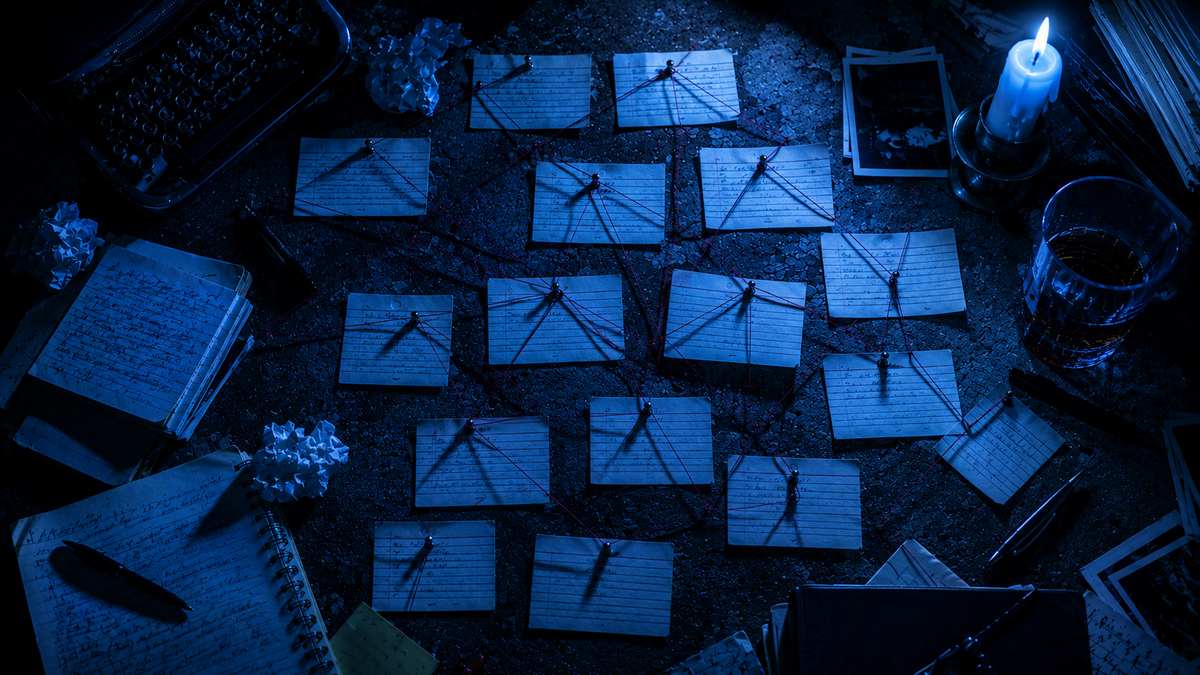
Definition of Plot: Structure & Examples
Plot is the causal sequence of events in a story — not what happens, but why things happen in the order they do. E.M. Forster put it precisely in 1927: "The king died and then the queen died" is a story. "The king died and then the queen died of grief" is a plot. The difference is causation. Plot is what turns a sequence of events into an argument.
That distinction matters for anyone trying to construct a narrative rather than simply report one. A story can be summarised. A plot has to be understood.
Plot vs story
The confusion between plot and story runs through most writing advice, and untangling it is worth the effort.
Story is the raw material — all the events that happen to or around the characters, in chronological order, whether or not they appear on the page or screen. Everything that occurred, from the character's childhood to what happens after the final scene.
Plot is the selection and arrangement of those events for the audience. Which events get shown, in what order, and with what emphasis. The same story material can produce radically different plots depending on those choices. *Citizen Kane* begins at the end and works backward through testimony and memory. *Gone Girl* splits its timeline and withholds its central event. *The Godfather Part II* runs two timelines in parallel. Same raw story material — a life, a crime, a family — arranged into a plot that produces specific effects the chronological telling would not.
The writer controls the plot. The story is given. The choices are where the art lives.
The structures that work
Plot structure is the pattern of tension and release, setup and payoff, complication and resolution that gives a story its shape. Several structures have proven durable across centuries of storytelling.
The three-act structure. The most widely used framework in Western narrative. Act one establishes the world and the protagonist's normal life, then disrupts it with an inciting incident that forces the protagonist into the story's central problem. Act two is the longest — the protagonist pursues their goal, faces escalating complications, reaches a low point, and finds a new resolve. Act three is the resolution: the final confrontation and its consequences. The structure is not a formula — it is a description of how tension accumulates and releases in satisfying narrative.
The hero's journey. Joseph Campbell's identification of a mythic structure present across cultures: the hero is called to adventure, crosses a threshold into an unfamiliar world, faces trials, finds allies and enemies, reaches the central ordeal, and returns transformed. Its influence on popular narrative — Star Wars, The Matrix, The Lion King — is so pervasive that it reads as natural rather than structural. It is deeply structural.
In medias res. Beginning in the middle of the action, with context filled in through flashback, dialogue, or gradual revelation. *The Iliad* begins nine years into the Trojan War. *Pulp Fiction* begins mid-dialogue. The technique creates immediate engagement and allows the writer to control the revelation of context rather than front-loading it.
The five-act structure. Shakespeare's preferred form, later codified by Gustav Freytag into the pattern known as Freytag's pyramid: exposition, rising action, climax, falling action, denouement. Television drama has adapted this structure across countless prestige series — each act break functioning as a point of escalation.
Kishōtenketsu. A four-act structure from Japanese and Chinese narrative tradition that does not rely on conflict as its engine. The first act introduces. The second develops. The third introduces a surprising twist or juxtaposition. The fourth reconciles. It produces stories that feel complete without the protagonist-antagonist conflict structure that Western narrative takes for granted. Its influence on Japanese manga, anime, and game design is substantial.
What makes a plot work
A plot works when every event is both surprising and inevitable in retrospect. The surprise is what keeps the audience engaged moment to moment. The inevitability — the sense, looking back, that it could not have gone any other way — is what makes the story feel earned rather than arbitrary.
This is harder to achieve than it sounds. A plot that is only surprising feels random. A plot that is only inevitable feels predictable. The balance — the event that the audience did not see coming but that, once it has happened, they could not imagine going otherwise — is the thing every plotting exercise is trying to find.
Three specific things produce this balance.
Plant and payoff. Every significant event in a plot should be prepared for before it occurs. A character trait established early pays off in the climax. A piece of information planted in act one returns with significance in act three. A Chekhov's Gun on the mantelpiece in act one fires by act three. The payoff is satisfying because the plant was there — the audience simply did not know what it was for.
Rising stakes. Each complication the protagonist encounters should be larger than the last, or more personal, or both. Escalation is not repetition. Each obstacle has to genuinely change the situation, not simply add more of the same pressure. The protagonist who faces the same problem three times with increasing difficulty is not in an escalating plot — they are in a repetitive one.
Character driving event. In a well-constructed plot, events happen because of who the characters are. The protagonist's choices, values, and flaws produce the complications they face. A plot where things happen to characters rather than because of them is a sequence of incidents, not a plot. The distinction is whether character generates event or event generates character response.
Plot in AI filmmaking
Every AI-generated film begins as a plot document — a sequence of scenes with causal relationships, setup-payoff structures, and escalating stakes — before it becomes a generation brief. The precision of that document determines the coherence of the film.
When directors build narrative films in Induce, the plot structure is not separate from the production pipeline — it is the foundation of it. Every scene brief references what came before and what needs to follow. The setup planted in scene 4 has to be visible in the generation brief for scene 4, so that when scene 23 pays it off, the system can verify that the necessary elements are present. A plot that holds together in the document produces a film that holds together on screen.
For a grounding in the screenplays where plot structure is most precisely executed — and what each one teaches — the screenplay examples post is the right next read.
What is the definition of plot?
+The causal sequence of events in a story — the selection and arrangement of events that gives a narrative its shape and produces meaning through the relationship between events, not just their sequence. E.M. Forster's formulation: "The king died and then the queen died of grief" is a plot. Causation is what separates plot from mere sequence.
What is the difference between plot and story?
+Story is all the events that occur in a narrative world, in chronological order, whether or not they are shown to the audience. Plot is the selection and arrangement of those events for the audience — which events get shown, in what order, and with what emphasis. The writer controls the plot. The story is the raw material the plot is made from.
What are the main types of plot structure?
+The most widely used are the three-act structure (setup, confrontation, resolution), the hero's journey (departure, initiation, return), in medias res (beginning mid-action), the five-act Freytag pyramid (exposition through denouement), and kishōtenketsu (a four-act structure from Japanese tradition that does not require conflict as its engine). Most narrative structures are variations or combinations of these.
What is a plot point?
+A significant event in a story that changes the direction or raises the stakes of the narrative. In three-act structure, the major plot points are the inciting incident (end of act one) and the climax (end of act two). Minor plot points are the complications and reversals that keep the tension escalating between these anchors.
What is the difference between plot and theme?
+Plot is what happens — the sequence of events and their causal relationships. Theme is what the story is about — the idea, question, or argument that the events collectively explore. A plot about a detective solving a murder can carry a theme about guilt, justice, identity, or mortality. The plot is the vehicle. The theme is the destination.
Related posts

What Is a Smash Cut? Definition & Examples
A smash cut is an abrupt edit that cuts mid-action to a completely different scene for deliberate effect. Here is how it works and the best examples.
By Ranga Nikhilesh
What Is a Prequel? Definition & Examples
A prequel is a story set before the original — made after it. Here is the definition, why most fail, and the examples that got it right.
By Ranga Nikhilesh

What Is It Called When an Actor Stays in Character?
When an actor stays in character between takes and throughout a production, it's called method acting- here is how it works.
By Prithvi Bharadwaj