Story & screenwriting7 min read
Screenplay Examples Every Filmmaker Should Study
The screenplay examples every filmmaker should read, and what each one teaches about structure, voice, and translating story into shots.
Screenplay Examples Every Filmmaker Should Study
Reading screenplays is one of the fastest ways to understand how film works. Don't just watch the films, read the scripts. A screenplay shows what the screen hides: the decisions behind a shot, what gets shown and what gets withheld, and how a scene is built before an actor or a camera enters it. Filmmakers who study scripts tend to learn things about their own work that they wouldn't pick up elsewhere.
What follows isn't a ranked list of the best screenplays ever written. It's a study guide. Each example was chosen for what it teaches, and for what a filmmaker can take away from reading it.
What a screenplay is, and what it is not
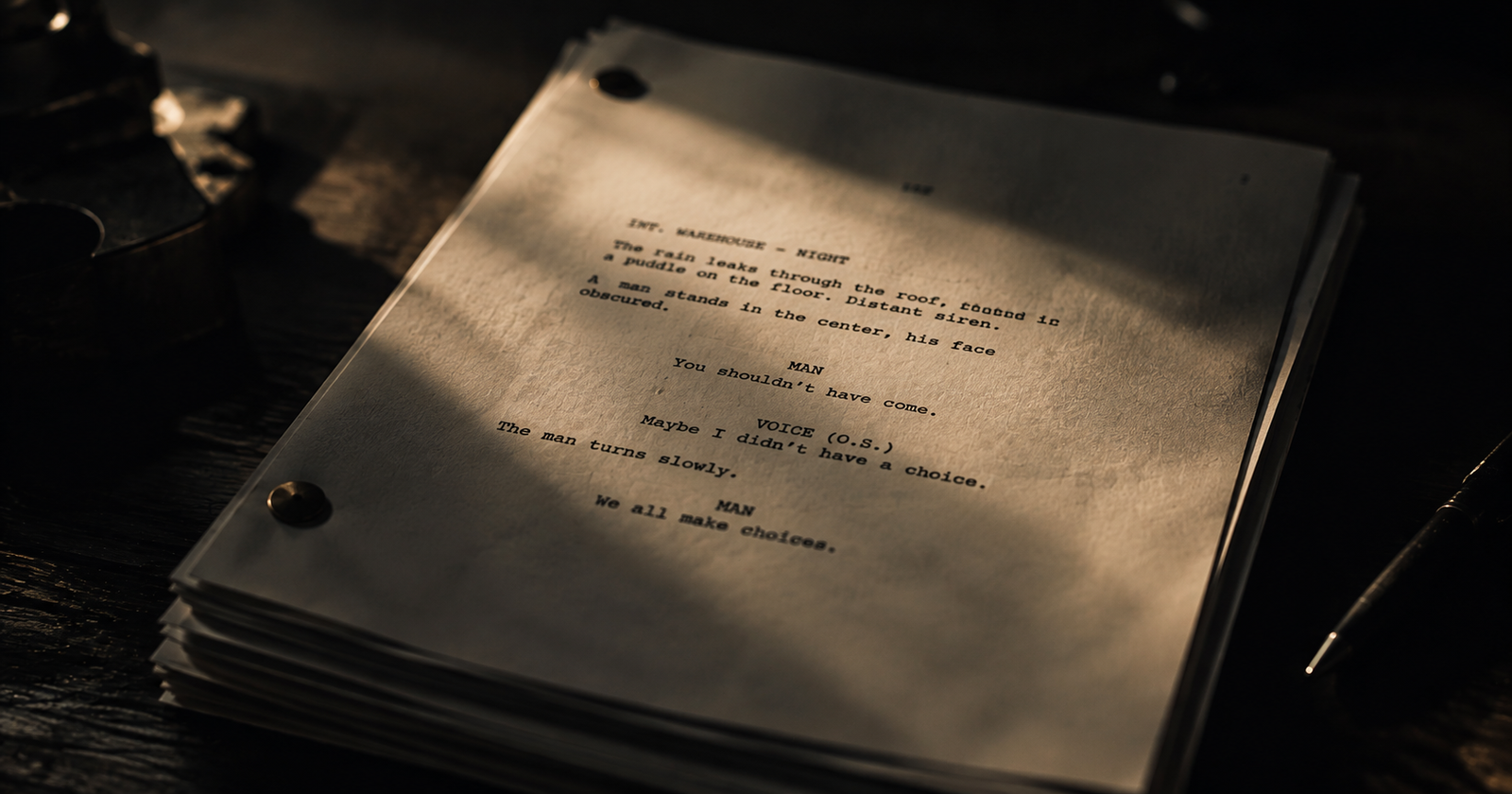
A screenplay is a document written to be filmed, not to be read for its own sake, and that shapes how it is written. Unlike a novel, it describes only what can be seen and heard. Unlike a stage play, it thinks in images and cuts rather than continuous performance. A page of properly formatted screenplay (12-point Courier, standard margins) runs to roughly one minute of screen time, and a feature runs ninety to one hundred and twenty pages. That limit forces economy, which is a central discipline of the form.
The format is standardised: scene headings (INT. or EXT., location, time of day), action lines that describe only what is visible on screen, character names centred above dialogue, and parentheticals used sparingly. The conventions exist for production practicality more than aesthetics, since a properly formatted script is a scheduling and budgeting document as much as a creative one.
What the format can't capture is voice, and voice is what separates a functional document from a piece of writing worth studying.
The examples, and what each teaches
Chinatown (1974): Robert Towne
What it teaches: structure, mystery, and dramatic irony.
Chinatown is among the most studied American screenplays of the 1970s. Towne's script works on two levels: the surface mystery of water rights and corruption in Los Angeles, and the deeper tragedy of a man who believes he has learned how the world works and is proven catastrophically wrong. Scenes often serve both levels at once, and information reaches the audience at carefully chosen moments.
A filmmaker reading it can learn how to use information: when to give the audience a piece of the puzzle and when to hold it back, how to write dialogue that means two things at once, and how to build an ending that feels both surprising and inevitable, which is very hard to do.
Pulp Fiction (1994): Quentin Tarantino and Roger Avary
What it teaches: non-linear structure and the relationship between dialogue and character.
Tarantino's script played with the convention that a story should proceed chronologically, and showed that an audience will follow multiple timelines if the writing earns their trust. The structure isn't the main lesson, though. The dialogue is.
Reading Pulp Fiction on the page is a different experience from watching it. The dialogue runs well past what a scene "needs": conversations about foot massages, fast food restaurants and television pilots go on long after their plot function is served. Tarantino seems to understand that character shows up in what people talk about when nothing is at stake, and the specificity of what his characters care about makes them feel real. That's what to look at when you read it.
Parasite (2019): Bong Joon-ho and Han Jin-won
What it teaches: how genre shifts and how to write a script that withholds its own meaning.
The Parasite screenplay moves between genres while keeping its intentions hidden from the audience. The first part plays as a dark comedy, the next as a thriller, and the last as something harder to name. Reading it, a filmmaker can learn how to manage tonal register, shifting the emotional world of a story without breaking the audience's trust, and how details planted early pay off in ways that feel both surprising and inevitable.
It also shows precision in action lines. Bong's description is specific about what matters in each frame, without telling a director where to put the camera.
No Country for Old Men (2005): Joel and Ethan Coen
What it teaches: restraint, and what you don't need to explain.
The Coen Brothers' adaptation of Cormac McCarthy's novel is a study in what to leave out. The script doesn't explain Anton Chigurh, justify the ending, or resolve the central violence. It trusts the audience to sit with ambiguity.
For filmmakers, the lesson is in the action lines. The description is extremely economical and keeps to what the camera will be on. Reading it shows how much trust you can extend to an audience and how much exposition you may not actually need.
Eternal Sunshine of the Spotless Mind (2004): Charlie Kaufman
What it teaches: how to externalise internal states cinematically.
Kaufman's script is technically very ambitious. It takes place largely inside a character's memory while that memory is being erased, so it has to communicate subjective, deteriorating psychological states through what can be seen and heard, without any of the tools available to a novelist. Reading it teaches a filmmaker to think of the screen as a surface for interior states as well as events.
The long descriptive passages Kaufman uses aren't a good formatting model, and a spec script written that way would likely be rejected. As a study of how to think cinematically about states of mind, though, it's worth reading.
The Godfather (1972): Mario Puzo and Francis Ford Coppola
What it teaches: adaptation, and the relationship between character and consequence.
Coppola's screenplay shows what to keep and what to cut. Puzo's novel is long and sprawling, while the film is concentrated. What survives is mostly what is essential to character: each remaining scene reveals something about who these people are and what the world they inhabit costs them.
The baptism sequence, in which Michael stands as godfather to his nephew while his enemies are systematically murdered, is a well-known example of parallel editing used to make a moral point. Reading the script shows how much of that was set up at the writing stage, not only in the edit.
Where to find produced screenplays
The scripts mentioned above are available legally through several sources. The Internet Movie Script Database (imsdb.com), Simply Scripts (simplyscripts.com), and the Writers Guild Foundation Library (wgfoundation.org) all maintain collections of produced screenplays. The Academy's Margaret Herrick Library holds original drafts and production documents for researchers. For working screenwriters, the Black List (blcklst.com) publishes an annual list of the most-liked unproduced scripts and makes many of them available to subscribers.
How a screenplay becomes a shot in AI filmmaking
A screenplay isn't only something a filmmaker reads. It's the source document a production works from. Every character description, location and piece of action on the page has to be translated into decisions about camera, lighting, blocking, and coverage.
In Induce, the screenplay is where a production begins. The system reads the script's intent (who is in the scene, what is at stake, what the scene needs to accomplish) and uses it to plan shots. Character descriptions become reference parameters, and the emotional logic of a scene shapes which shots are called and in what order. A precisely written script produces a more coherent shot list, and a more coherent shot list produces more consistent footage, so what the screenwriters above did well on economy, specificity, and visual thinking applies directly to AI filmmaking.
Frequently asked questions
A produced screenplay is the written document that was used as the basis for a film. Reading produced screenplays, rather than only formatting guides, is an effective way to understand how screenwriting works in practice, because you can compare the script to the finished film and see how each decision on the page translated to the screen.
The Internet Movie Script Database (imsdb.com), Simply Scripts (simplyscripts.com), and the Writers Guild Foundation Library (wgfoundation.org) all maintain legal collections of produced screenplays. The Academy Foundation's Margaret Herrick Library holds original drafts and production documents. Many studios and streaming services also release shooting scripts through their awards consideration campaigns.
Industry-standard screenplay format uses 12-point Courier font, standard margins (1 inch top, bottom, and right; 1.5 inches left), INT. or EXT. scene headings, action lines that describe only what is visible on screen, and centred character names above dialogue. One correctly formatted page equals approximately one minute of screen time.
Chinatown (1974) is the most commonly recommended starting point because its structure is so precise and so well documented. It is easy to see exactly what Towne is doing and why at each stage. After Chinatown, Pulp Fiction for voice and non-linear structure, and No Country for Old Men for economy and restraint.
The terms are often used interchangeably, but technically a screenplay is written specifically for film, describing action and dialogue intended for a camera. A script is a broader term that covers stage plays, television episodes, radio drama, and other performance formats. In common usage, both refer to the written document a production is based on.