What Is a Mexican Standoff? The Film Trope Explained
A Mexican standoff is a three-way deadlock where no one can act without being destroyed. Here is where it came from and how it works on screen.
A Mexican standoff is a three-way deadlock where no one can act without being destroyed. Here is where the trope came from, how Leone and Woo built the grammar, and what makes one work on screen.
What Is a Mexican Standoff? The Film Trope Explained
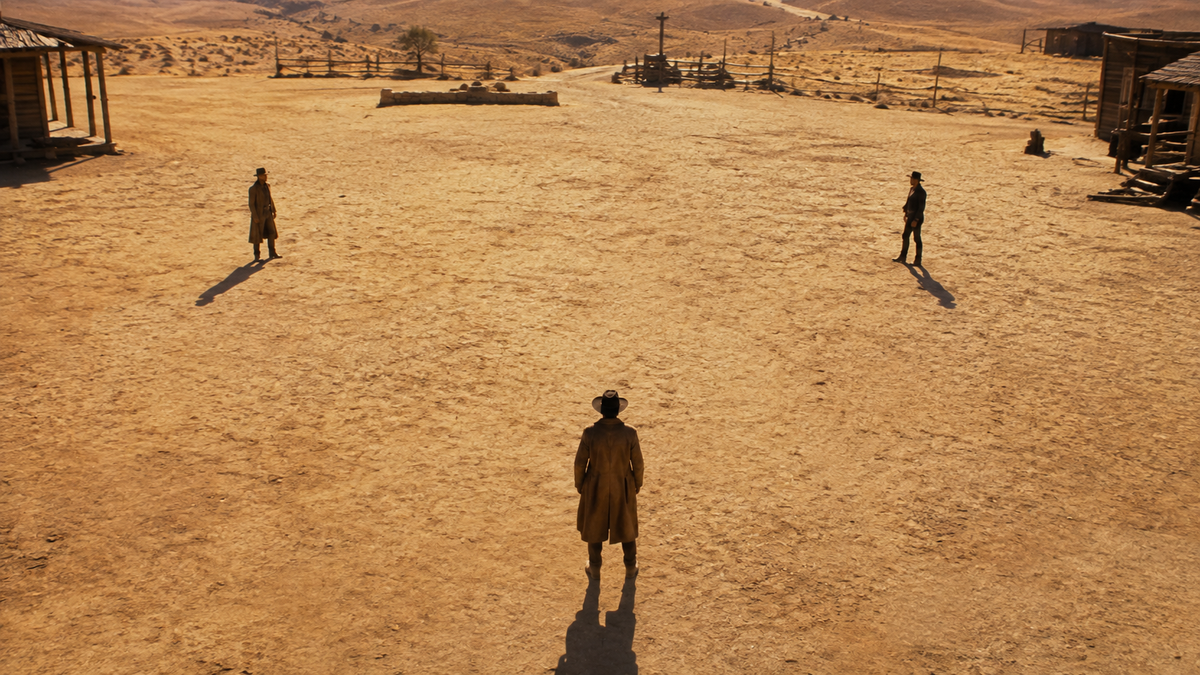
A Mexican standoff is a confrontation in which every party has a weapon trained on at least one other, and no one can act without triggering a response that destroys them. It is a deadlock by geometry: move, and you die. Stay still, and so does everyone else. The tension is the scene.
As a cinematic device it is one of the most recognisable and most borrowed tropes in film — a configuration of bodies and sightlines that compresses conflict into pure, frozen form.
Where the term comes from
The phrase predates cinema. Its first known print appearance is from 1876, in a short story about a gunfight where no party could gain the upper hand: *"We will call it a stand-off, a Mexican stand-off — you lose your money, but you save your life."* The term migrated into mainstream English to describe any unresolvable impasse, and cinema inherited it from there.
The name has no settled etymology. One theory traces it to the Mexican–American War. Another suggests it is the generic othering that attaches "Mexican" to things perceived as chaotic or ungovernable. Either way, the name stuck, and the trope it describes became one of the defining configurations of Western and action cinema.
How Leone built the grammar
The scene that codified the Mexican standoff as a cinematic form is the cemetery sequence in Sergio Leone's *The Good, the Bad and the Ugly* (1966). Blondie, Tuco, and Angel Eyes face each other in a triangle across a dusty graveyard. The confrontation runs for nearly three minutes without a single shot — sustained entirely by cross-cutting close-ups of eyes, hands, holsters, and faces, set against Ennio Morricone's score building to near-unbearable intensity.
What Leone understood is that the standoff is not about the guns. It is about information asymmetry and nerve. Blondie knows something the others do not. The camera holds on eyes because eyes are where that knowledge might leak. The geometry forces the audience to watch all three men simultaneously and do the same calculation each of them is doing: who will move first, and can I be faster?
That grammar — triangular staging, extreme close-ups, withholding resolution until the last possible moment — became the template every subsequent standoff borrows from.
John Woo and the Hong Kong reinvention
If Leone invented the grammar, John Woo turned it into a visual style. Through films like *The Killer* (1989) and *Hard Boiled* (1992), Woo took the standoff's structural deadlock and injected it with the choreographic logic of Chinese opera and wuxia — fluid, almost balletic, with guns functioning as expressive instruments rather than tools of simple violence.
Where Leone's standoffs are still and geological, Woo's are kinetic and emotional. Characters frequently end up in standoffs not as enemies but as men who respect or love each other, which makes the geometry even more agonising. The threat of violence and the weight of loyalty occupy the same frame.
Quentin Tarantino absorbed both influences and made the standoff structural. *Reservoir Dogs* (1992) opens in the aftermath of one and climaxes in another. *Pulp Fiction* ends in a diner standoff that resolves not in violence but in negotiation — a reminder that the device does not require a body count, only the credible threat of one.
What makes one work
The standoff is a device for externalising psychological states that cannot be spoken. When characters cannot trust each other, cannot retreat, and cannot advance without consequence, the standoff gives that paralysis a physical form the audience can see.
It fails when the geometry is unclear — when the audience cannot track who is pointing at whom, or when the blocking makes the deadlock feel arbitrary rather than inevitable. It fails when it is used decoratively, as visual punctuation, rather than as a genuine expression of the story's stakes. And it fails when it resolves too quickly, before the audience has had time to feel the weight of the trap.
The best standoffs earn their resolution. The audience needs to sit inside the impossibility long enough to feel it — to do the arithmetic themselves, to understand why no one is moving, to dread the moment that breaks the silence.
What makes a standoff fail
Three failure modes appear in almost every bad standoff sequence. The geometry is unreadable — the audience cannot track who is pointing at whom, so the deadlock feels abstract rather than physical. The scene resolves before the pressure has built — the director cuts away too soon, before the audience has done the same calculation the characters are doing. Or the standoff is decorative — inserted for visual interest rather than earned through story stakes, which the audience feels immediately even if they cannot name it.
How standoff sequences get directed with AI
Every standoff is a camera problem as much as a writing problem. The triangular geometry needs to be readable in every cut. The close-ups need to land in the right order. The blocking needs to make the deadlock visible without stating it.
When directing a standoff sequence through Induce, the scene begins in the script — the tension, the who-knows-what, the stakes — and the system reads it. Shot composition follows from emotional intent: which character holds information, where the camera needs to be to show the audience what the characters are hiding from each other, how the cuts accelerate as the scene approaches its break. The director still makes those decisions. What changes is how directly the script's intentions translate into a shot list, and how consistently those decisions hold across every cut in the sequence.
What is a Mexican standoff?
+A confrontation where every party has a weapon aimed at at least one other, creating a deadlock — no one can act without triggering a response that destroys them. It ends in sudden violence, mutual negotiation, or outside intervention.
Where does the term come from?
+Its first known print use is from 1876. The etymology is disputed — possible origins include the Mexican–American War and a broader habit of attaching "Mexican" to situations perceived as ungovernable or chaotic.
What is the most famous Mexican standoff in film?
+The cemetery sequence in Sergio Leone's *The Good, the Bad and the Ugly* (1966) — a three-way confrontation between Blondie, Tuco, and Angel Eyes that runs nearly three minutes and established the visual grammar every subsequent standoff borrows from.
Does a Mexican standoff have to involve three people?
+No. Two parties can produce a standoff if both are armed and neither can act without triggering retaliation. The three-way version is more cinematically common because the triangular geometry complicates the calculation and forces more complex blocking.
How does a Mexican standoff end?
+Three ways: sudden violence where one party acts and accepts the consequences; mutual surrender or negotiation; or outside intervention that changes the terms of the deadlock.
What directors are most associated with the Mexican standoff?
+Sergio Leone established the visual grammar in *The Good, the Bad and the Ugly* (1966). John Woo reinvented it as a kinetic, emotional set piece across his Hong Kong action films in the late 1980s and 1990s. Quentin Tarantino made it structural — using standoffs as both opening and closing devices across *Reservoir Dogs* and *Pulp Fiction*.
Related posts
What Is a Synopsis? How to Write One That Works
A synopsis is not a summary — it is a sales document that proves your story works. Here is what it must include and how to write one that gets read.
By Ranga Nikhilesh
What Is a Smash Cut? Definition & Examples
A smash cut is an abrupt edit that cuts mid-action to a completely different scene for deliberate effect. Here is how it works and the best examples.
By Ranga Nikhilesh
What Is a Foil in Literature? Definition & Examples
A foil is a character who contrasts with another to reveal qualities neither could show alone. Here is the definition, how it works, and the best examples.
By Ranga Nikhilesh