Screenplay Examples Every Filmmaker Should Study
The screenplay examples every filmmaker should read — and what each one actually teaches about structure, voice, and translating story into shots.
Screenplay Examples Every Filmmaker Should Study
Reading screenplays is the fastest way to understand how film actually works. Not watching films — reading the scripts. A screenplay makes visible what the screen hides: the decisions behind the shot, the logic of what gets shown and what gets withheld, the architecture of a scene before an actor or a camera enters it. Every filmmaker who studies scripts comes away understanding something about their own work that they could not have learned any other way.
What follows is not a ranked list of the best screenplays ever written. It is a study guide — each example chosen for what it teaches, and what specifically a filmmaker takes away from reading it.
What a screenplay is, and what it is not
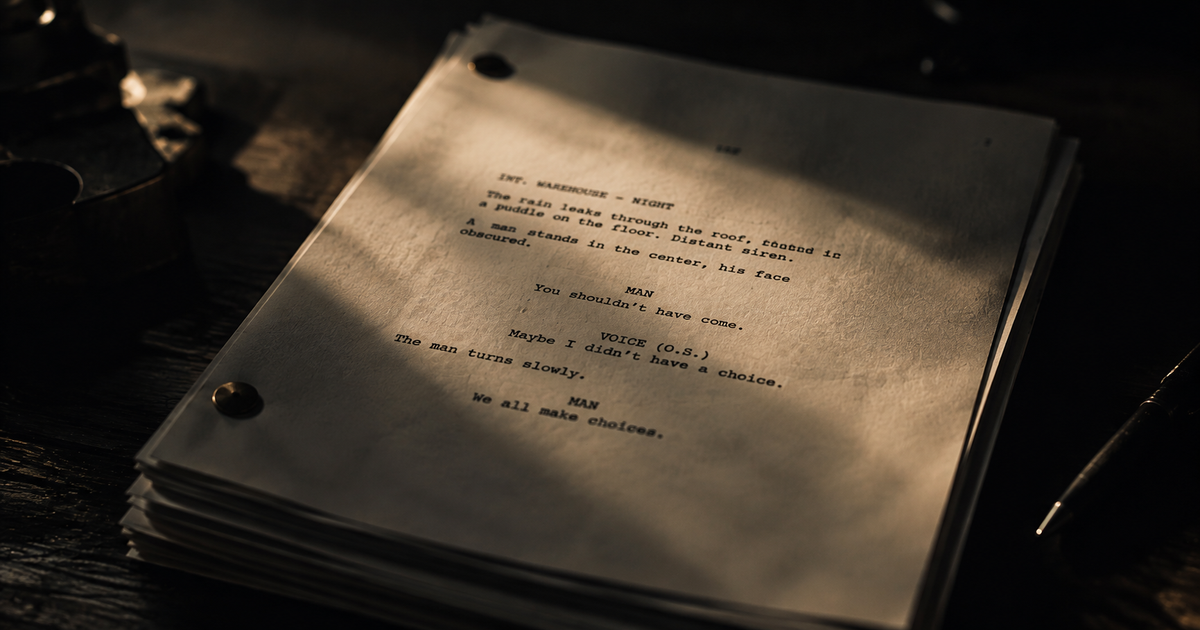
A screenplay is a document written to be filmed, not to be read. That distinction shapes everything about how it is written. Unlike a novel, it describes only what can be seen and heard. Unlike a stage play, it thinks in images and cuts rather than in continuous performance. A page of properly formatted screenplay — 12-point Courier, standard margins — equates to roughly one minute of screen time. A feature runs ninety to one hundred and twenty pages. That constraint is not arbitrary: it enforces economy, which is the central discipline of the form.
The format is standardised: scene headings (INT. or EXT., location, time of day), action lines that describe only what is visible on screen, character names centred above dialogue, and parentheticals used sparingly. The conventions exist not for aesthetic reasons but for production practicality — a properly formatted script is a scheduling and budgeting document as much as a creative one.
What the format cannot capture is voice. And voice is what separates a script that reads as a functional document from one that reads as a piece of writing worth studying.
The examples — and what each teaches
Chinatown (1974) — Robert Towne
What it teaches: structure, mystery, and the architecture of dramatic irony.
Chinatown is the most studied American screenplay of the 1970s for a reason. Towne's script operates on two levels simultaneously: the surface mystery of water rights and corruption in Los Angeles, and the deeper tragedy of a man who believes he has learned how the world works and is proven catastrophically wrong. Every scene does double duty. Every piece of information the audience receives is calibrated to arrive at exactly the right moment.
What a filmmaker learns from reading it: how to use information. When to give the audience a piece of the puzzle and when to withhold it. How to write dialogue that means two things at once. And how to construct an ending that is both a surprise and an inevitability — the hardest thing in screenwriting.
Pulp Fiction (1994) — Quentin Tarantino and Roger Avary
What it teaches: non-linear structure and the relationship between dialogue and character.
Tarantino's script broke the convention that story must proceed chronologically and proved that an audience can hold multiple timelines in their heads if the writing is compelling enough to earn that trust. But the structure is not the lesson. The dialogue is.
Reading Pulp Fiction on the page is a different experience from watching it. The dialogue extends far past what a scene "needs" — conversations about foot massages and fast food restaurants and television pilots run long past their plot function. What Tarantino understood is that character is revealed not in moments of crisis but in what people talk about when nothing is at stake. The specificity of what his characters care about is what makes them real. That is the thing to study.
Parasite (2019) — Bong Joon-ho and Han Jin-won
What it teaches: how genre shifts and how to write a script that withholds its own meaning.
The Parasite screenplay is unusual because it was written to conceal its intentions from the audience even as it executes them precisely. The first act reads as a dark comedy. The second as a thriller. The third as something the script does not have a genre name for. Reading it, a filmmaker learns how to manage tonal register — how to shift the emotional world of a story without breaking the audience's trust, and how every detail planted early pays out in a way that feels both surprising and inevitable.
It also teaches visual precision in action lines. Bong writes description that is specific without being prescriptive — he tells you exactly what matters in each frame without telling a director where to put the camera.
No Country for Old Men (2005) — Joel and Ethan Coen
What it teaches: restraint, and what you do not need to explain.
The Coen Brothers' adaptation of Cormac McCarthy is a study in what to leave out. The script does not explain Anton Chigurh. It does not justify the ending. It does not resolve the central violence. It trusts the audience to sit with ambiguity and finds that ambiguity more honest than resolution would be.
For filmmakers, the lesson is in the action lines. The Coens write description with extraordinary economy — they name only what the camera will be on, and they never editorialize. Reading it is a lesson in how much trust you can extend to an audience and how much exposition you do not actually need.
Eternal Sunshine of the Spotless Mind (2004) — Charlie Kaufman
What it teaches: how to externalise internal states cinematically.
Kaufman's script is the most technically ambitious on this list. It takes place primarily inside a character's memory while that memory is being erased, and it has to communicate subjective, deteriorating psychological states through images and sound — through what can be seen and heard — without any of the tools available to a novelist. Reading it teaches a filmmaker to think about the screen as a surface for interiority, not just event.
The long descriptive passages Kaufman uses are not recommended as a formatting model — they would be rejected in a spec script. But as a study in how to think cinematically about states of mind, the script has no equal.
The Godfather (1972) — Mario Puzo and Francis Ford Coppola
What it teaches: adaptation, and the relationship between character and consequence.
Coppola's screenplay is a lesson in what to keep and what to cut. Puzo's novel is long and sprawling; the film is concentrated and architectural. What survives is whatever is essential to character. Every scene that remains does so because it reveals something about who these people are and what the world they inhabit costs them.
The baptism sequence — Michael's nephew being baptised while his enemies are systematically murdered, intercut with Coppola's precise economy — is a master class in parallel editing as moral argument. Reading it tells you how that argument was constructed at the script stage, not in the edit.
Where to find produced screenplays
The scripts mentioned above are available legally through several sources. The Internet Movie Script Database (imsdb.com), Simply Scripts (simplyscripts.com), and the Writers Guild Foundation Library (wgfoundation.org) all maintain collections of produced screenplays. The Academy Foundation's Margaret Herrick Library holds original drafts and production documents for researchers. For working screenwriters, the Black List (blcklst.com) publishes an annual list of the most-circulated unproduced scripts and makes many of them available to subscribers.
How a screenplay becomes a shot in AI filmmaking
A screenplay is not just a document a filmmaker reads. It is the source document that a production operates from. Every character description, every location, every piece of action that appears on the page has to be translated into decisions about camera, lighting, blocking, and coverage.
In AI filmmaking, that translation is literal. When a director works in Induce, the screenplay is where the production begins. The system reads the script's intent — who is in the scene, what is at stake, what the scene needs to accomplish — and uses that to plan shots. The character descriptions become reference parameters. The emotional logic of a scene shapes which shots are called and in what order. The gap between a great screenplay and a mediocre one is not just a creative difference. It is a production difference: a precisely written script produces a more coherent shot list, and a more coherent shot list produces more consistent footage. What the screenwriters on this list understood about economy, specificity, and visual thinking turns out to be exactly what AI filmmaking requires.
What is a screenplay example?
+A produced screenplay is the written document that was used as the basis for a film. Reading produced screenplays — rather than studying formatting guides — is the most effective way to understand how screenwriting works in practice, because you can compare the script to the finished film and see how each decision on the page translated to the screen.
Where can I find screenplay examples to read?
+The Internet Movie Script Database (imsdb.com), Simply Scripts (simplyscripts.com), and the Writers Guild Foundation Library (wgfoundation.org) all maintain legal collections of produced screenplays. The Academy Foundation's Margaret Herrick Library holds original drafts and production documents. Many studios and streaming services also release shooting scripts through their awards consideration campaigns.
What is the correct format for a screenplay?
+Industry-standard screenplay format uses 12-point Courier font, standard margins (1 inch top, bottom, and right; 1.5 inches left), INT. or EXT. scene headings, action lines that describe only what is visible on screen, and centred character names above dialogue. One correctly formatted page equals approximately one minute of screen time.
Which screenplay should I read first?
+Chinatown (1974) is the most commonly recommended starting point because its structure is so precise and so well documented. It is easy to see exactly what Towne is doing and why at each stage. After Chinatown, Pulp Fiction for voice and non-linear structure, and No Country for Old Men for economy and restraint.
What is the difference between a screenplay and a script?
+The terms are often used interchangeably, but technically a screenplay is written specifically for film — it describes action and dialogue intended for a camera. A script is a broader term that covers stage plays, television episodes, radio drama, and other performance formats. In common usage, both refer to the written document a production is based on.
Related posts
What Is a Synopsis? How to Write One That Works
A synopsis is not a summary — it is a sales document that proves your story works. Here is what it must include and how to write one that gets read.
By Ranga Nikhilesh

What Is a Smash Cut? Definition & Examples
A smash cut is an abrupt edit that cuts mid-action to a completely different scene for deliberate effect. Here is how it works and the best examples.
By Ranga Nikhilesh
What Is a Foil in Literature? Definition & Examples
A foil is a character who contrasts with another to reveal qualities neither could show alone. Here is the definition, how it works, and the best examples.
By Ranga Nikhilesh