AI-Generated Movies: Where We Are in 2026
AI-generated movies crossed a threshold in 2026. Here is what changed and what it takes to make one that holds together.
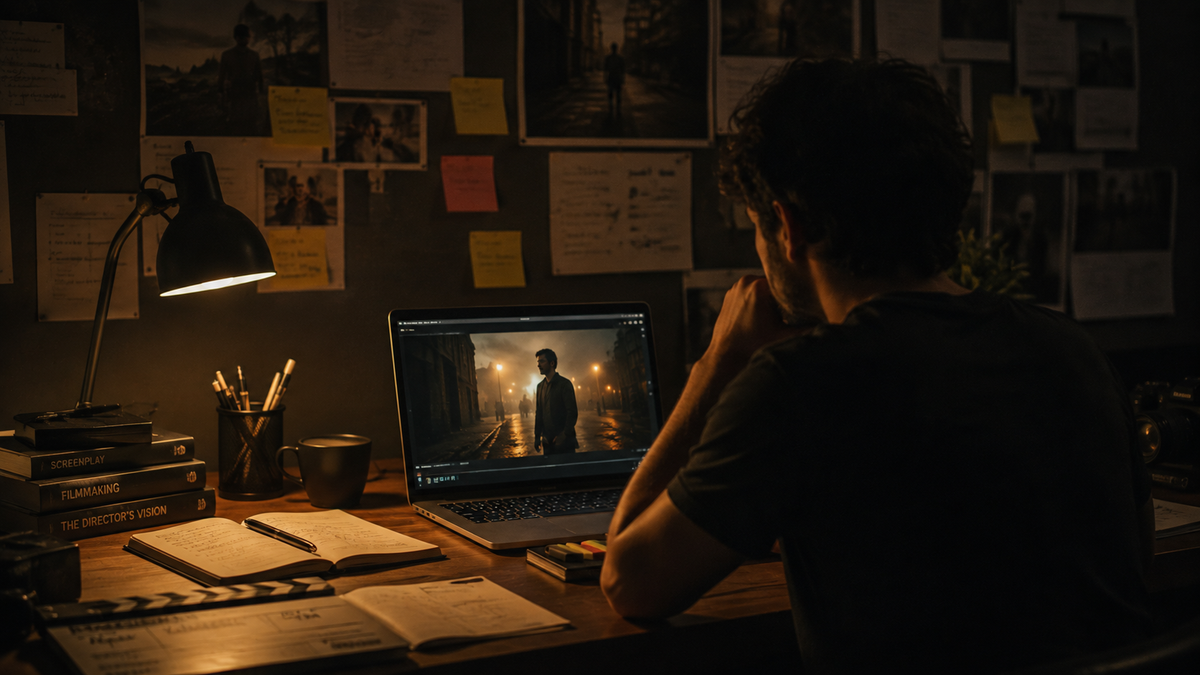
AI-Generated Movies: Where We Are in 2026
AI-generated movies crossed a threshold in 2026. Not a theoretical one — a visible, audience-facing one. Several narrative short films premiered at Sundance 2026 that had been partially or fully generated using tools like Runway Gen-4 and Veo 3.1. They were not experimental noise. They were coherent narrative shorts with consistent characters, held lighting, and scenes that cut together. A year earlier, that was not possible.
What changed, what the best current examples prove, and what it still takes to make a film that actually works — that is what this post covers.
What changed in 2026
The technical problem that made AI video unusable for narrative filmmaking until recently was consistency. Diffusion models generate each frame, each clip, each scene as a fresh event with no memory of what came before. Characters would subtly shift between shots. Faces would drift. The lighting world would not hold. Editors would receive footage that looked impressive in isolation and could not be cut together.
That problem did not disappear in 2026. But it became manageable in a way it was not before.
Three things shifted. First, the generation models themselves got significantly better at holding character and environment consistency within a single clip. Runway Gen-4.5, Veo 3.1, Kling 3.0, and Seedance 2.5 all produce clips where internal coherence — within a single shot — is now reliable enough for professional use. Second, reference conditioning improved. You can now feed a character reference image to most major models and get results consistent enough to use across multiple shots. Third, a layer of production tooling emerged above the raw models — platforms and infrastructure that manage the consistency problem at the workflow level rather than hoping the model solves it automatically.
The result, as Sundance 2026 showed, is that short-form AI narrative filmmaking is production-ready. The question has shifted from "can you make a coherent scene" to "can you make a coherent film."
What the best examples prove
The strongest AI-generated short films in 2026 share a consistent characteristic: they were made by filmmakers who understood that the generation layer is not the hard part. The hard part is everything around it.
*Snow Shovelers*, one of the most discussed AI shorts of 2026, works because its director built the tension through editing logic and pacing — the AI generated the images, but the film's effect comes from what gets shown and when. The atmospheric consistency across the piece comes from a locked visual reference for the location and weather conditions applied to every generation, not from the model spontaneously deciding to hold the world together.
*After Us* — a dialogue-free short about a world after human extinction — succeeds because its concept does not require character consistency across scenes. Each location is new. That is not a creative compromise; it is a production decision that works with the technology's strengths rather than against them. Smart filmmakers in 2026 are designing stories that suit the medium.
What neither film, nor any AI film to date, solves is the feature-length problem. Maintaining character identity, narrative continuity, and a coherent visual world across ninety minutes of generated footage remains beyond what any current workflow handles reliably without significant manual intervention.
What it takes to make one
Making an AI-generated film in 2026 involves more production planning than most people expect, and less generation skill than most people assume. The generation is the easy part. The planning is everything.
Script and shot breakdown first. Every film that works starts with a document that is more detailed than a conventional screenplay — each scene broken into individual shots, each shot described with enough specificity that a generation model can be briefed precisely. Vague descriptions produce vague footage. Specific descriptions — character position, emotional state, camera distance, lighting quality, key props — produce usable material.
Lock references before generating anything. Every character who appears in more than one shot needs a locked reference image generated before production begins. Every recurring location needs a reference for its lighting world and color palette. These travel into every generation call that features them. Without them, consistency is luck. With them, it is systematic.
Design for the technology's strengths. The films that work in 2026 tend to avoid the things that still break: complex dialogue scenes where lip sync has to be perfect across many cuts, intricate multi-character blocking in tight spaces, or extremely long takes. They lean into what the models do well: atmospheric establishing shots, emotional close-ups, environments, motion, and the kind of visual poetry that a generation model produces almost accidentally when given a precise brief.
Verify before you edit. Every clip that enters your edit should have been checked against the shot description and the character reference before you accept it. A clip that looks good but contradicts your reference — wrong costume, shifted face, incorrect location detail — will undermine the film's coherence even if no individual viewer can name why it feels off. The continuity check is not optional.
The production infrastructure problem
The practical ceiling for AI filmmaking in 2026 is not generation quality. It is production infrastructure.
A raw generation model does not know your screenplay. It does not know your characters. It does not know what the previous shot established or what the next one requires. Each call is stateless. Managing the continuity that connects those calls — holding the story's logic across forty or sixty or two hundred generation events — is manual work if you are doing it yourself, and it does not scale.
This is the problem the Project Memory Graph at Induce addresses directly. Rather than managing character references, location rules, and shot-level decisions manually across every generation, the Memory Graph holds all of it in a persistent structure that every subsequent generation reads from. When scene 34 needs the same character who appeared in scene 3, the system does not require you to remember and reattach the reference — it already knows. When a clip comes back that contradicts what the production decided, Rhapsody flags it before it reaches the timeline.
For a filmmaker making a thirty-second social clip, none of this matters. For anyone making something with recurring characters, multiple locations, and a real narrative arc, the production infrastructure is where the film either holds together or falls apart. That is the gap Induce was built to close — and why the most interesting AI films being made right now are not being made with a single model and a lot of manual work, but with a story-first pipeline that treats the models as interchangeable engines and owns the correctness layer above them.
What is an AI-generated movie?
+A film where artificial intelligence tools are used to generate some or all of the visual content, audio, or narrative elements. In 2026, most AI-generated films are assembled from multiple short generated clips rather than produced end-to-end by a single system. The filmmaker's role shifts from executing each shot manually to directing a generation pipeline — writing precise briefs, locking visual references, verifying output, and editing the resulting footage.
Are there any good AI-generated movies in 2026?
+Yes. Several narrative short films at Sundance 2026 demonstrated that AI-generated footage can hold together across a coherent story at short form. Films like *Snow Shovelers* and *After Us* are strong examples of filmmakers working with the technology's strengths rather than against them. Feature-length AI filmmaking remains a significant production challenge.
Can AI generate a full-length film?
+Not reliably end-to-end in 2026. Individual scenes can be generated to a high standard. The challenge at feature length is maintaining character identity, narrative continuity, and a coherent visual world across the full runtime — which requires production infrastructure above the model layer, not just better generation.
What tools are used to make AI-generated movies?
+The primary generation models in 2026 are Runway Gen-4.5, Veo 3.1, Kling 3.0, and Seedance 2.5 for video; Midjourney and FLUX 2 for key art and storyboards; ElevenLabs for voice; and Suno for AI-generated score. For productions that need to hold together across multiple shots, platforms like Induce sit above these models and manage the consistency and verification layer.
Will AI replace filmmakers?
+No, but it is changing what filmmakers do. The generation layer handles execution. The creative decisions, what the story is about, what each shot needs to accomplish, how the cuts should feel, what the performances mean, remain entirely human. What AI changes is the cost and speed of production, and the set of filmmakers who can access professional-quality output.
Related posts
What Is a Synopsis? How to Write One That Works
A synopsis is not a summary — it is a sales document that proves your story works. Here is what it must include and how to write one that gets read.
By Ranga Nikhilesh

What Is a Smash Cut? Definition & Examples
A smash cut is an abrupt edit that cuts mid-action to a completely different scene for deliberate effect. Here is how it works and the best examples.
By Ranga Nikhilesh
What Is a Foil in Literature? Definition & Examples
A foil is a character who contrasts with another to reveal qualities neither could show alone. Here is the definition, how it works, and the best examples.
By Ranga Nikhilesh